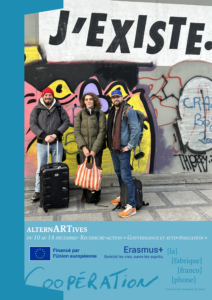
Action-research no. 1 — Brussels, December 2025
Brussels: meeting one another — Episode 1
Recorded in Watermael-Boitsfort, December 2025.
Produced by Marie Pons / Collectif Forêt Noire
Arrival
La Vénerie hosted the team from La Fabrique Francophone for four days in Watermael-Boitsfort, opening the project with a look at its day-to-day workings. Two buildings, two histories: the Écuries, home to the Centre d’Expression et de Créativité (Centre for Expression and Creativity), and the Espace Delvaux, occupied by the Centre Culturel (Cultural Centre).The starting question: how does a cultural organisation evaluate its work — with whom, and by what criteria?
The Steering Council (Conseil d’orientation)
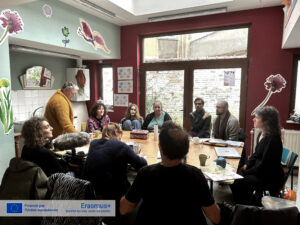
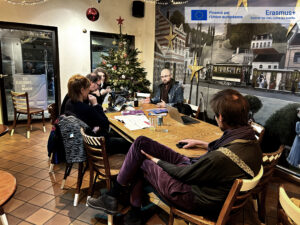
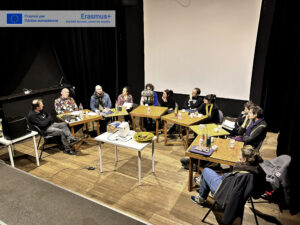
The group took part in the body through which La Vénerie examines its programming together with residents, neighbourhood associations, the CPAS (public social-welfare centre), the library, the community centres and its board. Three hours of collective discussion, assessment grid in hand, with direct questions: did the “audience reached” match the “audience intended”? Was the project initiated by citizens or by local associations?
The alternARTives participants then discussed how these evaluation practices stand in relation to the cultural-rights framework.
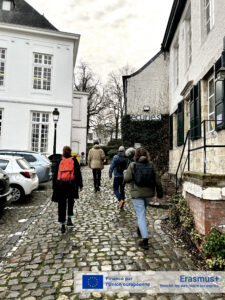
Site visits
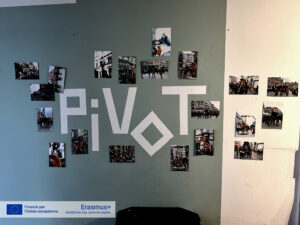
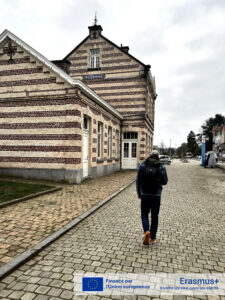
Le Pivot, in Etterbeek — a Centre for Expression and Creativity that has worked since 1971 with families living in severe hardship.
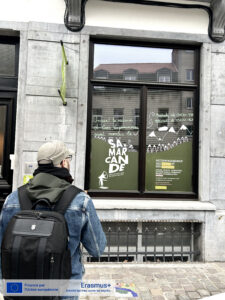
AMO Samarcande and its Samarc’Ondes project, a sound library built from what young people supported by the IPPJ (youth-protection service) agreed to contribute to it.
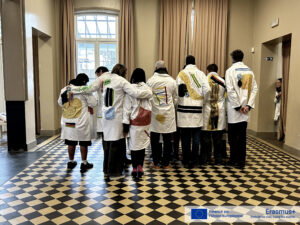
The workshop “Au nom du chœur” — visual arts, theatre and performance with young people with intellectual disabilities — followed by the working meeting of the team that runs it.
The tools worked on
Drawing on the work carried out by the Laboratoire des Droits Culturels and the Opale resource centre with the ESS’Perluette questionnaire, and on La Vénerie’s own self-evaluation approach — its “Boussole” (Compass) and its grid — the partners began to co-build a self-evaluation questionnaire focused on the quality of relational spaces.
So what came of it?
The focus shifted towards describing relationships in qualitative terms: naming what unfolds between people, beyond attendance figures. Another approach took hold in the discussions — that of spaces for recourse, where disagreement and the full recognition of each person can find expression.
This first activity marked an initial step in how cultural rights reshaped our thinking: from doing for to doing with.